Perspectives • Urban Development
Who gets to build the missing middle?
Gentle density is reshaping how cities grow, but the tools haven’t caught up yet.
What does “gentle density” or “missing middle” mean? Is it an accessory dwelling unit (ADU) such as a coach house, garden suite, or mother-in-law apartment? Is it replacing single family homes with a 2-, 4-, or 6-unit multiplex? Stacked town homes? The truth is that these are all valid approaches to gentle density. Gentle density is adding density in traditionally single-family home neighbourhoods without significantly changing the scale of the buildings in that neighbourhood. Like all real estate issues, gentle density is a location specific challenge.
There is a lot of excitement around gentle density opportunities as cities, provinces, and even nations adopt policies and programs to support and encourage this type of growth. Planning and development veterans won’t be surprised that adding density to a neighbourhood can be a challenging process. The difference with gentle density development is that many of these projects will be led by new players such as home-owners, contractors, and new small-scale developers. These people are likely to be surprised and then overwhelmed by the challenge of figuring out what they are allowed to build and how to get through a construction process.
Many of these projects will be led by new players such as home-owners, contractors, and new small-scale developers. These people are likely to be surprised and then overwhelmed by the challenge.
What can be built here? It seems like a simple question, but in most neighbourhoods, it is incredibly complex. Overlapping policies, infrastructure capacity, and local precedents are all important factors and are likely to be documented in disparate places if they are documented at all. Resources like Ratio.City make it easier to find all the applicable factors in one place, but interpretation is required by the developer. Unfortunately, cities and utilities often make finding relevant data about a site deliberately difficult to obtain as they want developers to engage with them as part of the approval process. A stronger commitment to open data, clear as-of-right development potential, and consistent funding for infrastructure would go a long way to filling up the pipeline of development projects of all scales from gentle to high densities.
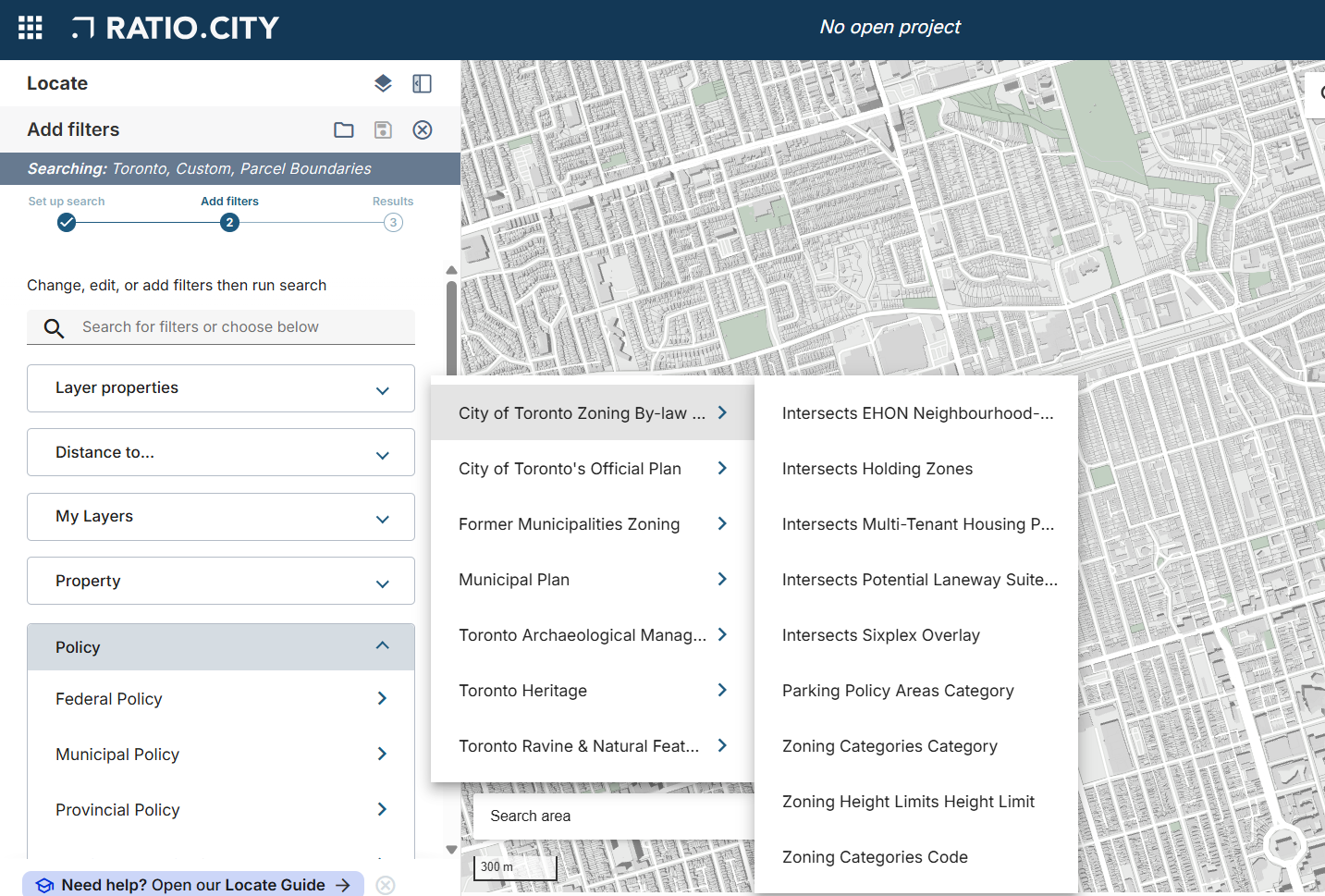
We propose a workflow adapted from Ratio.City’s approach to helping mid- and high-rise developers find and validate sites for their projects. Our platform is designed to make it easy to find sites that have the right policy, infrastructure, and neighbourhood characteristics for development. We make it simple to explore the development potential of a site in three dimensions and test how many units could be built on a site. For gentle density we propose to start with site identification tools and a small but growing catalog of multiplex massing templates. We believe that this will help people get started on their development journey by understanding where multiplexes can be built and what kinds of gentle density are appropriate for their site.
In addition to finding appropriately sized designs for a site, we know that financial viability is a key consideration. Tools and calculators for construction costs and income potential are critical to understanding if a project is viable. To assist with this, we are working to bring more demographic data into the Ratio.City platform and to bring useful calculators into our existing floor area and unit metrics.
Join the conversation
We want to engage with the gentle density community and understand what tools we could provide to make this new kind of development possible. If you are interested in participating in the discussion we’d love to hear from you!